

August 20, 2026
Jesse Jackson net worth was estimated at around $4 million at the time of his death on February 17, 2026, at age 84, though broader estimates from other outlets range as high as $9–10 million. The figure is modest for a man who ran for president twice and spent six decades as one of America’s most visible civil rights leaders. It reflects a career built on nonprofit salaries and speaking fees rather than business ownership or investments.
Jesse Jackson: Quick Facts
| Detail | Information |
|---|---|
| Full Name | Jesse Louis Jackson Sr. |
| Alternate Name | Jesse Louis Burns |
| Date of Birth | October 8, 1941 |
| Date of Death | February 17, 2026 (age 84) |
| Birthplace | Greenville, South Carolina |
| Nationality | American |
| Height | 6 ft 3 in (1.91 m) |
| Occupation | Civil rights leader, Baptist minister, political activist |
| Family Name | Jackson |
| Spouse | Jacqueline Lavinia Brown (m. 1962) |
| Children | 6, including Santita, Jesse Jr., and Jonathan |
| Estimated Net Worth | $4 million (some estimates up to $9–10 million) |
| Primary Income Sources | Nonprofit salaries, speaking fees, CNN hosting, book royalties |
What Was Jesse Jackson’s Net Worth at the Time of His Death?
Jackson’s estimated net worth of roughly $4 million is modest compared with his stature as a national political figure. For comparison, he ran for president twice, negotiated the release of hostages held overseas, and stood beside Dr. Martin Luther King Jr. during the most consequential years of the civil rights movement. Yet, his personal fortune never approached the wealth typically associated with figures of that profile.
The reason isn’t mysterious. Jackson spent his career leading nonprofit organizations, not businesses. His income came from modest, publicly disclosed salaries, speaking engagements, media appearances, and book deals rather than equity stakes, real estate empires, or corporate ownership. That funding model simply doesn’t generate the kind of wealth seen among entertainers, athletes, or business executives.
It’s also worth noting that the $4 million figure is an estimate, not a verified financial statement. Jackson opened his books to the public only once, in 2001, and no comparable disclosure was made again before his 2023 retirement from active leadership of the Rainbow PUSH Coalition.
How Jesse Jackson Built His Career and His Income
Jackson’s earning history tracks closely with his activism, since nearly every major income stream in his life flowed through an organization he founded or led.
Operation Breadbasket and the SCLC Years
Jackson joined the Southern Christian Leadership Conference in the mid-1960s and became a close ally of Dr. King, who appointed him to lead the Chicago chapter of Operation Breadbasket. The program used boycotts and negotiations to pressure companies to hire Black workers and invest in Black communities. This was Jackson’s first real leadership role, and it set the pattern for the rest of his career: income tied to a salaried position within a nonprofit civil rights organization.
Operation PUSH and the Rainbow Coalition
After King’s assassination in 1968, tensions inside the SCLC led to Jackson’s departure in 1971. He founded Operation PUSH (People United to Save Humanity) that same year, with a focus on economic empowerment, education, and voter registration. In 1984, he broadened his platform by launching the National Rainbow Coalition, which aimed to unite Black Americans, Latinos, organized labor, and other marginalized groups into a single political force. The two organizations merged in 1996 to form the Rainbow PUSH Coalition, which Jackson led until stepping down in 2023.
These organizations were the financial backbone of Jackson’s career. His salary, travel reimbursements, and much of his public profile were tied directly to his leadership positions within them.
Presidential Campaigns
Jackson ran for the Democratic presidential nomination in both 1984 and 1988, becoming one of the first Black candidates to mount a serious run for the office. He won roughly 3.2 million primary votes in 1984 and nearly 7 million votes in 1988, capturing 29% of the total Democratic primary vote that year. While unsuccessful, both campaigns cemented his national political standing and opened doors to speaking engagements and media work that would later contribute to his income.
Early Life: From Segregated Greenville to National Stage
Jesse Jackson was born on October 8, 1941, in Greenville, South Carolina, to teenage mother Helen Burns. In 1943, Helen married Charles Henry Jackson, who later adopted him and gave him his surname.
Raised under Jim Crow segregation, Jackson attended Sterling High School, where he was student body president and a standout athlete. He briefly attended the University of Illinois on a football scholarship before transferring to North Carolina A&T State University, a historically Black college where his activism took root.
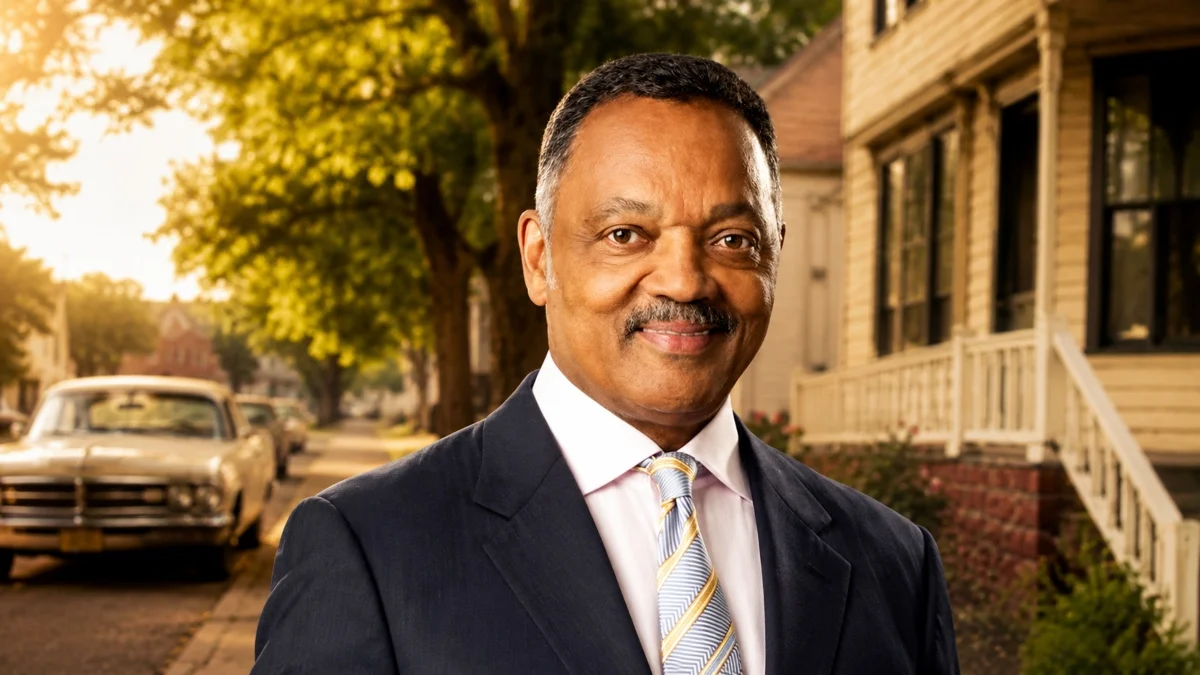
Jackson earned a sociology degree in 1964 and began a Master of Divinity program at Chicago Theological Seminary, leaving in 1965 to join the civil rights movement full time. The seminary awarded him his degree in 2000, decades later. He grew up with no family wealth. Every dollar Jackson later earned came from work he built himself.
Where the Money Actually Came From: Income Breakdown
Jackson’s finances are unusually well documented for certain years and almost entirely undocumented for others. Here’s what the public record actually shows.
| Income Source | Details | Status |
|---|---|---|
| Combined salary (4 orgs, 2001) | $120,000/year | Tribune disclosure |
| CNN hosting salary | $5,000/week, “Both Sides” (1992–2000) | Tribune disclosure |
| Travel budget (2001) | $614,000 spent; $450,000 DNC reimbursed | Disclosed |
| Family business income (1986–87) | $210,000+ combined | Tribune report |
| Speaking fees | Up to $25,000/appearance (1990s) | Largely unknown |
| Book royalties, later income | Not itemized | Unknown |
The biggest gap in this picture is speaking income. In his own 2001 financial disclosure, Jackson listed a category of speaking-related earnings as simply “undisclosed,” a rare admission from a public figure who was otherwise trying to demonstrate transparency.
That gap has never been filled by any subsequent report, which is part of why net worth estimates for Jackson vary widely, ranging from $4 million to $10 million depending on the source.
The 2001 Financial Disclosure and the PUSH Excel Audit
Two events shaped the public’s understanding of Jackson’s finances.
In 1979, a federal audit of PUSH Excel found $737,000 in misspent grant funds and flagged another $1 million for review. The government sued in 1984, and PUSH Excel repaid $550,000 by 1993.
In March 2001, amid scrutiny over a $35,000 severance tied to an extramarital affair, Jackson gave the Chicago Tribune a 102-page financial disclosure, his only one ever made public. Its salary and hosting figures are broken down in the income table above; no equivalent disclosure had been made before his 2026 death.
Separately, a 2008 IRS complaint accused Jackson’s Citizenship Education Fund of paying over $1 million in unnamed consulting fees. His team disputed it, and no audit result ever resolved the claim.
Assets and Real Estate
Public records on Jackson’s actual assets are thin compared to his salary figures, but a few data points have surfaced over the years.
A 1987 Chicago Tribune investigation found that Jackson’s wife, Jacqueline, held the majority of the family’s assets in her name, valued at $400,000–$600,000 at the time, roughly $1.2–$1.7 million in today’s dollars after adjusting for inflation. Separately, mid-1980s reporting placed the couple’s holdings in Inter City Broadcast Corporation stock at over $250,000.
No public record shows Jackson owning significant commercial real estate or investment property. His family’s known wealth appears to have been held mostly in stocks and shared assets rather than landholdings.
Media Career: CNN and Public Speaking
Beyond activism, Jackson built a modest but steady media career. From 1992 to 2000, he hosted “Both Sides with Jesse Jackson” on CNN, a weekly public affairs program centered on live debates between guests on opposing sides of major political and social issues. The show gave Jackson a national platform separate from his organizational leadership roles, and its pay was one of the few sources of his income that the public ever saw in exact figures (see the table above).
His public speaking career ran parallel to this, with appearances at colleges, churches, and corporate events for most of his adult life. Unlike the CNN salary, this income stream was never fully itemized a gap that outlives him in every net worth estimate published since his death.
Jesse Jackson vs. Other Civil Rights-Era Leaders
Because so many of Jackson’s peers came from similar nonprofit- and activism-based backgrounds, direct net worth comparisons are difficult. Few of these figures have net worth estimates from a major financial outlet, since none built wealth through conventional business ownership.
| Name | Career | Public Net Worth Data |
|---|---|---|
| Jesse Jackson | Civil rights leader, minister, two-time presidential candidate | ~$4 million (estimated) |
| Al Sharpton | Civil rights leader, minister, media host | No confirmed disclosure; estimates vary widely |
| John Lewis | Civil rights leader, U.S. Congressman | Modest, tied largely to congressional salary |
| Cornel West | Academic, activist, author | No named-outlet figure available |
The consistent theme across this group is that activism-based careers, even at the highest level of national visibility, rarely translate into large personal fortunes. Income comes from salaries, honoraria, and book deals rather than from equity or asset ownership, which naturally caps how much wealth can accumulate over a lifetime.
Political Career Beyond the Campaign Trail
Jackson’s influence in politics extended well past his two presidential runs. From 1991 to 1997, he served as one of two unpaid “shadow senators” representing the District of Columbia, advocating for D.C. statehood and voting rights. The position carried no legislative authority and, notably, no salary another example of Jackson taking on high-profile public roles that added to his political capital without adding meaningfully to his personal finances.
He remained an influential voice within the Democratic Party for decades afterward, supporting Bill Clinton in 1992, endorsing Barack Obama in 2008, and later backing both Hillary Clinton and Bernie Sanders in subsequent election cycles.
Personal Life, Family, and Later Years
Jackson married Jacqueline Lavinia Brown in December 1962, and the couple had five children together: Santita, Jesse Jr., Jonathan, Yusef, and Jacqueline. Several of his children went on to their own public careers. Jesse Jackson Jr. served as a U.S. Congressman from Illinois from 1995 until his resignation in 2012.
He was later sentenced to 30 months in federal prison in 2013 after pleading guilty to misusing $750,000 in campaign funds, a financial scandal separate from his father’s own record. Jonathan Jackson was elected to represent Illinois’s 1st Congressional District in 2022.
In 2001, Jackson publicly acknowledged that he had fathered a sixth child, Ashley, in 1999 with Karin Stanford, a former staff member of his organization. He accepted financial responsibility and maintained a relationship with his daughter afterward.

Jackson’s health declined significantly in his final decade. He announced a Parkinson’s disease diagnosis in November 2017, and in 2025 his organization disclosed he was also affected by progressive supranuclear palsy, a rare and severe neurodegenerative condition. He stepped down as leader of the Rainbow PUSH Coalition in 2023 but continued to attend public events when possible. He was hospitalized in November 2025 and died at his Chicago home, surrounded by family, on February 17, 2026.
Final Thoughts
Jesse Jackson’s estimated $4 million net worth reflects a career built on activism rather than accumulation. He spent over five decades leading nonprofit organizations, running historic presidential campaigns, hosting a national television program, and negotiating on the world stage, all while drawing a relatively modest, publicly disclosed salary.
The gaps in his financial record, particularly around speaking fees, mean the true figure will likely never be fully known. But the number itself was never really the point of his career. Jackson’s legacy was built on the causes he championed and the doors he opened for others, not on the size of his personal fortune.
Financial details in this article draw on Jackson’s 2001 disclosure to the Chicago Tribune, reported at the time by CBS News, along with public net worth estimates from Celebrity Net Worth.
Frequently Asked Questions (FAQs)
What was Jesse Jackson’s net worth when he died?
Most estimates put it at around $4 million, though broader calculations can reach $9–10 million, depending on how speaking fees and royalties are factored in.
How did Jesse Jackson make his money?
Primarily through salaries from the nonprofit organizations he led (Operation PUSH and later Rainbow PUSH Coalition), a CNN hosting salary, public speaking fees, and book royalties.
Did Jesse Jackson inherit any wealth?
No. He was born in segregated Greenville, South Carolina, with no family wealth, and built his entire career and income from his own work in activism, ministry, and media.
Why do net worth estimates for Jesse Jackson vary so much?
Because his own 2001 financial disclosure, the most detailed one ever made public, explicitly labeled part of his speaking income as “undisclosed.” No later report ever closed that gap, so outlets rely on decades-old figures combined with estimates.
Was Jesse Jackson involved in any financial controversies?
Yes. A 1979 federal audit found $737,000 in misspent PUSH Excel grant funds, leading to a lawsuit and a $550,000 repayment completed by 1993. A separate 2008 IRS complaint over consulting fees at his Citizenship Education Fund was never publicly resolved either way.