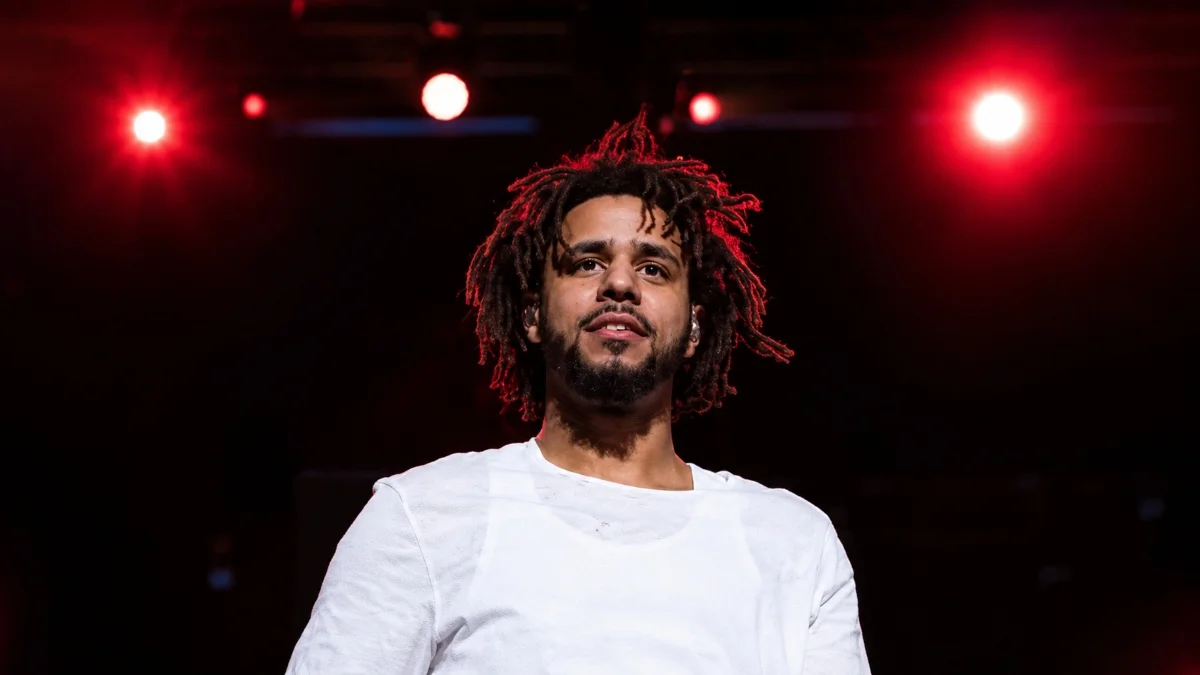
J Cole net worth stands at an estimated $60 million as of 2026, according to Celebrity Net Worth, with some estimates ranging as high as $65–75 million once his NBA ownership stake and touring income are factored in. One of the most respected names in hip-hop, Cole has built a diversified fortune through music, his Dreamville label, and a minority stake in the Charlotte Hornets, going far beyond just record sales.
Who Is J. Cole?
J. Cole is easily one of the most successful and impactful hip-hop artists of our time. Instead of just tracking viral radio hits, he built his multi-million-dollar empire on deep storytelling, pleasant skill, and a massive, dedicated fanbase. Over his career, he has dropped several multi-platinum albums like 2014 Forest Hills Drive and KOD. Most recently in 2026, he made waves again by releasing his highly anticipated studio project, The Fall-Off, alongside a surprise EP titled Birthday Blizzard ’26.
J. Cole Profile Overview
| Attribute | Details |
|---|---|
| Full Name | Jermaine Lamarr Cole |
| Known As | J. Cole |
| Profession | Rapper, Songwriter, Record Producer |
| Estimated Net Worth (2026) | $60 Million (Estimated) |
| Date of Birth | January 28, 1985 |
| Age | 41 Years (2026) |
| Birthplace | Frankfurt, West Germany |
| Nationality | American |
| Height | 6 ft 2 in (188 cm) |
| Education | St. John’s University (Magna Cum Laude) |
| Marital Status | Married |
| Children | 2 |
| Genres | Hip Hop, Conscious Rap |
| Years Active | 2007–Present |
| Record Labels | Dreamville Records, Roc Nation, Interscope Records |
| Main Income Sources | Music sales, streaming royalties, concert tours, Dreamville Records, music production, brand partnerships, and investments |
| Notable Albums | 2014 Forest Hills Drive, KOD, The Off-Season, 4 Your Eyez Only |
| Notable Achievement | Grammy Award-winning rapper and founder of Dreamville Records |
| Official Website | dreamville.com |
| Social Media | Instagram: @realcoleworld • X (Twitter): @JColeNC |
Early Life and Path to Music
Cole was born in Germany, where his father was stationed as a U.S. Army serviceman, before his family relocated to Fayetteville, North Carolina. This city continues to shape much of his songwriting and public identity today. He later attended St. John’s University in New York on an academic scholarship, graduating magna cum laude with a degree in communications and business while simultaneously grinding on his early mixtapes.
That combination fans and critics have often cited a disciplined academic background paired with relentless creative output- is a reason Cole’s career decisions, from label negotiations to his more recent sports investment, tend to look more calculated than those of many of his peers.
Breaking Into the Industry
These classic mixtapes made massive buzz online well before radio stations started playing his music. His underground grind was so loud that it caught the awareness of Jay-Z, who immediately made Cole the very first artist signed to his newly formed Roc Nation label in 2009.
J Cole Net Worth Growth Timeline (2011–2026)
| Year | Estimated Net Worth |
|---|---|
| 2011 | ~$5 Million |
| 2013 | ~$8 Million |
| 2015 | ~$15 Million |
| 2017 | ~$25 Million |
| 2019 | ~$35 Million |
| 2021 | ~$45 Million |
| 2023 | ~$55 Million |
| 2025 | ~$60 Million |
| 2026 | ~$60 Million |
Note: These figures are estimated values based on J. Cole’s music earnings, album sales, streaming revenue, touring income, Dreamville Records, investments, and other business ventures.
How Did J. Cole Build His Wealth?
Cole’s fortune wasn’t built overnight. It’s the product of over a decade of album sales, sold-out tours, smart business partnerships, and more recently a major move into professional sports ownership.
Music Sales and Streaming
Cole’s studio albums have consistently topped the Billboard 200, and several, including 2014 Forest Hills Drive and KOD, have gone multi-platinum. His catalog continues to generate significant streaming revenue years after release; 2014 Forest Hills Drive alone has spent hundreds of weeks on the Billboard charts, a rare feat that speaks to how well his older material continues to perform on streaming platforms long after its original release window.
Cole is also notable for being one of very few artists to have gone platinum with an album that contained no guest features. This distinction reinforces both his commercial appeal and his songwriting reputation. That kind of sustained catalog value is a major, ongoing contributor to his net worth, since streaming royalties compound year after year rather than being a one-time payout.
His 2026 release, The Fall-Off, debuted at No. 1 on the Billboard 200 and performed strongly across international charts, giving his catalog another commercially successful entry to build on going forward.
Touring Revenue
Touring is one of the biggest income streams for any major recording artist, and Cole is no exception. Reports have noted his tour stops approaching seven figures per show during peak years, contributing heavily to his overall earnings. Unlike streaming income, which is typically split across labels, distributors, and songwriting credits, touring revenue tends to flow much more directly to the artist, which is why headline tours remain one of the fastest ways for musicians at Cole’s level to build liquid wealth.
Cole has also headlined and curated large-scale festivals, most notably the Dreamville Festival in Raleigh, North Carolina, which ran annually from 2018 until it paused in recent years. Beyond ticket sales, festivals like this generate revenue through sponsorships, vendor partnerships, and merchandising, all of which flow back to Cole either directly or through Dreamville.
Songwriting and Production Credits
Beyond his own catalog, Cole has writing and production credits on records for other major artists, which generate additional royalty income outside of his solo releases. As an executive producer for Dreamville’s roster and compilation projects, he also earns from a wider body of work than just the music released under his own name.
Dreamville Records
Cole founded Dreamville Records, a label and creative collective that has launched the careers of artists like J.I.D, Bas, EarthGang, and Ari Lennox. Beyond the roster’s commercial success, Dreamville also produced the massively popular Revenge of the Dreamers III compilation album, further boosting Cole’s production and executive credits and his income.
As both founder and de facto figurehead of the label, Cole benefits financially from the success of every act on the roster, not just his own releases. This model, building a label around a collective of artists rather than operating purely as a solo act, has given Cole a more diversified and durable revenue base than many of his peers who rely almost entirely on their own output.
Charlotte Hornets Ownership
In 2023, Cole became a minority owner of the NBA’s Charlotte Hornets, joining a buyer group led by Gabe Plotkin and Rick Schnall that purchased the team from Michael Jordan in a deal valuing the franchise at roughly $3 billion, up sharply from the $275 million Jordan paid for majority control in 2010. Jordan retained a minority stake rather than exiting fully. Other co-owners include country star Eric Church, along with investors Dan Sundheim, Ian Loring, Chris Shumway, Dyal HomeCourt Partners, and Charlotte locals Amy Levine Dawson and Damian Mills.
For the North Carolina-born rapper, it’s a full-circle move. In 2021, Cole briefly played pro basketball for the Rwanda Patriots and Canada’s Scarborough Shooting Stars before shifting to the ownership side of the sport. NBA teams are becoming more valuable every single year. By owning a piece of the Hornets, J. Cole has secured a massive real-world investment that will keep making him money completely independent of the music business and streaming algorithms.
Philanthropy and the Dreamville Foundation
While it isn’t a source of income, Cole’s Dreamville Foundation, established in 2011, is a notable part of his public profile. The foundation supports underserved youth in his hometown of Fayetteville, and Cole has directed proceeds from select shows and ventures, including a rent-free housing initiative for single mothers, toward the cause. This community-focused reputation has also strengthened brand partnerships and goodwill around his name.
In 2015, Cole purchased his childhood home in Fayetteville, the same house that appeared on the cover of 2014 Forest Hills Drive, with plans to convert it into rent-free housing for single mothers. He has also hosted “Dollar and a Dream” concerts, low-cost shows where all proceeds are funneled directly into the Dreamville Foundation rather than kept as personal income. While these initiatives don’t add to his net worth, they’ve played a meaningful role in shaping his public image as one of hip-hop’s more grounded, community-first figures. This reputation in turn supports long-term brand value and audience loyalty.
Read more: Trick Daddy Net Worth
Lifestyle and Spending Habits
Even with a $60 million fortune, J. Cole is famous for living a surprisingly low-key life. Unlike many mainstream rappers who spend millions on iced-out chains, supercar caravans, or flashy clothing lines, Cole chooses to invest his capital back into long-term, respected assets, his record label, and community charity projects.
This more understated approach to spending is one reason some analysts believe Cole’s actual liquid net worth may be higher than public estimates suggest, since a larger share of his earnings appears to go toward long-term assets like his Hornets stake, his label, and his foundation rather than depreciating luxury purchases.
J. Cole’s Net Worth Compared to Other Top Rappers
| Rapper | Estimated Net Worth (2026) |
|---|---|
| Jay-Z | $2.5 billion+ |
| Diddy | $400 million (disputed/declining) |
| Dr. Dre | $500 million+ |
| Drake | $250 million |
| Kendrick Lamar | $75 million |
| J. Cole | $60 million |
| 21 Savage | $30 million |
While Cole’s net worth is lower than some of his peers, this partly reflects his approach to the industry: he’s released fewer commercial ventures (clothing lines, alcohol brands, tech investments) compared to artists like Jay-Z or Diddy, focusing instead on music, Dreamville, and now sports ownership.
It’s also worth noting that net worth comparisons across the hip-hop industry can be misleading. Jay-Z’s fortune, for example, is built heavily on liquor brands (Armand de Brignac and D’Ussé), an early stake in Uber, and the sale of Tidal, none of which are directly comparable to a recording artist’s music-based income.
Dr Dre’s wealth is similarly tied to a single outsized event: the sale of Beats Electronics to Apple in 2014. Cole’s wealth, by contrast, is more directly tied to his ongoing output as a musician and label head, plus the newer Hornets investment, making it in some ways a more “organic” measure of his career earnings relative to artists whose fortunes hinge on one or two massive business exits.
Personal Life
J. Cole was born in Frankfurt, Germany, while his father was stationed there in the U.S. Army, which gives him dual American and German citizenship. He was raised primarily in Fayetteville, North Carolina, a city that remains central to his music and identity.
Cole met his wife, Melissa Heholt, while both were students at St. John’s University in New York, and the couple married in a private ceremony in 2015. They have two children together. True to form, Cole and Heholt keep their family life almost entirely out of the public eye, rarely discussing their kids by name or sharing photos, which is consistent with the low-key, business-first image he’s cultivated throughout his career.
Read more: Master P Net Worth
Career Timeline and Key Milestones
| Year | Milestone |
|---|---|
| 2007 | Releases debut mixtape, The Come Up. |
| 2009 | Signs with Jay-Z’s Roc Nation as its first artist. |
| 2011 | Releases debut album Cole World: The Sideline Story; founds Dreamville Foundation. |
| 2014 | Releases 2014 Forest Hills Drive, later certified multi-platinum. |
| 2018 | Releases KOD; launches Dreamville Festival in Raleigh, NC. |
| 2021 | Releases The Off-Season; briefly plays professional basketball in Rwanda and Canada. |
| 2023 | Becomes minority owner of the Charlotte Hornets. |
| 2026 | Releases The Fall-Off and surprise EP Birthday Blizzard ’26. |
Does J. Cole Own Any Businesses?
Yes. Cole’s primary business venture is Dreamville Records, which operates as both a label and a creative collective under the Interscope/Roc Nation umbrella. He’s also the founder of the Dreamville Foundation, a nonprofit, and as of 2023 a minority owner of the Charlotte Hornets, one of the more unique holdings among his hip-hop peers.
Unlike some contemporaries, Cole has largely stayed out of the crowded celebrity liquor, fashion, and tech-startup space, keeping his business interests relatively concentrated.
Final Thoughts
J. Cole’s $60 million net worth is proof that you can build a massive fortune by staying true to your art. While other hip-hop moguls made billions through corporate clothing lines or liquor deals, Cole took a cleaner route. He focused on dropping classic albums, mentoring next-generation artists through Dreamville Records, and making smart long-term investments like his NBA team stake. Even if he stops touring or retires from rapping, his businesses will keep growing his wealth for years to come.
Frequently Asked Questions (FAQs)
How does J. Cole make most of his money?
Cole earns primarily through album sales, streaming royalties, touring, and his Dreamville Records label. His minority ownership stake in the Charlotte Hornets is also a significant, appreciating asset.
Does J. Cole own part of an NBA team?
Yes. In 2023, Cole joined a buyer group that purchased the Charlotte Hornets from Michael Jordan, becoming a minority owner of the franchise.
Is J. Cole richer than Drake?
No. Drake’s estimated net worth (around $250 million) is significantly higher than J. Cole’s. Drake has more diversified business ventures, including his own record label and multiple brand partnerships.
Is J. Cole still making music?
Yes, though Cole has suggested that his 2026 album The Fall-Off may be his last full studio project. He also released a surprise EP, Birthday Blizzard ’26, around the same time.
How much does J. Cole earn per year?
In strong touring years, Cole’s annual earnings have been estimated at around $30 million, factoring in touring, streaming royalties, and Dreamville Records income. Earnings can vary significantly year to year depending on whether he’s actively touring or releasing new music.